Govern AI with clarity, confidence, and care.
A concise, practitioner-focused library on AI governance — principles, vocabulary, and training your team can use today.
Learning modules
Open any module below — no sign-in required.
AI Governance Overview
The frameworks, roles, and lifecycle controls that guide responsible AI in modern organizations.
Open →For Beginners
A plain-language introduction to AI governance for non-technical readers stepping into the field.
Open →Vocabulary
The essential terminology — from model cards to algorithmic impact assessments — every practitioner should know.
Open →Management Training Day
A structured training program preparing leaders to operationalize AI governance across their teams.
Open →AI Ethics and Governance
A practitioner guide bridging AI ethics principles — fairness, transparency, accountability — with the operational governance controls that make them real.
Open →Healthcare Case Study
A detailed, step-by-step case study on governing clinical AI, vendor contracts, fairness, and monitoring.
Open →Supply Chain Case Study
A step-by-step case study on tiered risk, differential privacy, and continuous audit for AI across procurement, freight, and routing.
Open →Retail Banking Case Study
An original scenario governing credit-decisioning, fraud, and a customer-service copilot at a regional retail bank.
Open →Insurance Claims Case Study
An original scenario governing FNOL triage, computer-vision auto-damage estimation, and fraud detection at a property & casualty insurer.
Open →Core principles
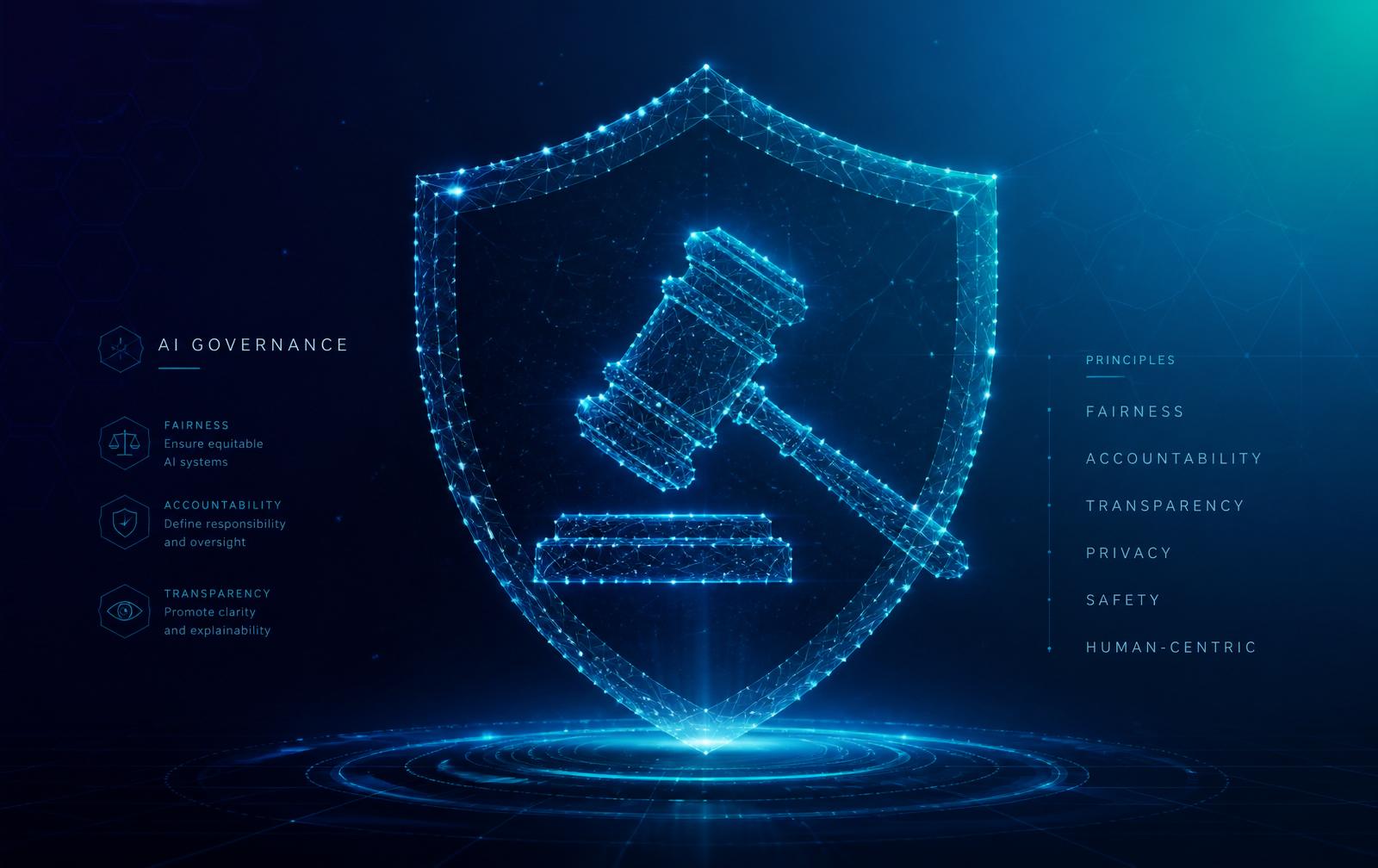
The shared values every AI governance framework returns to.
Fairness
Design AI systems that treat people equitably and mitigate bias.
Accountability
Assign clear ownership and oversight across the AI lifecycle.
Transparency
Explain how models work, what they decide, and why.
Privacy
Protect personal data and honor consent by design.
Safety
Test rigorously and monitor systems for harm in production.
Human-Centric
Keep humans meaningfully in the loop for high-stakes decisions.
Why AI Governance?
AI is now embedded in decisions that affect people's lives, livelihoods, and rights. Good governance turns abstract ethics into concrete controls — policies, reviews, documentation, and monitoring — so teams can move quickly without moving carelessly.
Curated by Kashif. Get in touch for speaking, workshops, or advisory work.